Showing posts with label composition. Show all posts

Sunday, March 2, 2014

Thoughts on Visual Design and Composition

The White Rabbit put on his spectacles. `Where shall I begin, please your Majesty?' he asked. `Begin at the beginning,' the King said gravely, ‘and go on till you come to the end: then stop.'   -- Alice's Adventures in Wonderland


If The White Rabbit were discussing painting composition: where to begin?  How to begin?


For the past couple of years, I've been searching for guidelines/rules/suggestions/NYFCN(Name Your Favourite Composition Noun) on how to compose a painting. I found and studied the 7 elements and the 8 principles, centres of interest, Fibonacci, golden ratio/rectangle/spot, the rule of thirds, value studies, and various composition checklists.  I located more than 100 websites with design or visual composition information.  Some very good; others not so good.  I don’t know how many art books I read in addition to the 30 or so books I purchased.  In all these resources, I never found a visual compositional framework until I obtained a copy of Ian Roberts' Mastering Composition, via my local library.


Early in his book, Ian introduces The Foundation of the Painting, and illustrations that contains the five planes of a picture.
  1. The Dynamics of the Picture Plane. Each proportion and scale of every painting-square, vertical or horizontal-has a special dynamic that affects and is affected by every mark or shape you put on it. The edges of your picture plane are the four most important lines in your composition since they, in the most basic sense, define the foundation you are starting with.
  2. Armature. The fundamental lines of direction or flow that connects the man compositional movement to the picture plane.  
  3. Abstract Shapes. The building blocks of the painting. Each shape is interacting with every other shape. This really is where the success or failure of the painting lies.
  4. Subjects. Bottles, mountains, kids on the beaches/
  5. Details. Highlights, wrought-iron street lamps and almost anything else painted with a little pointed brush.
Ian comments on picture plane 1-3: "This is where the real artistic thinking has to occur before you start to paint", and on points 4-5: "This is often where inexperienced painters focus their attention. The result is a lack of artistic clarity and drama in their paintings".


This is where I first started to understand visual composition. These five bullet points present a nearly complete visual design framework.  When I went back and reviewed Whitney, Brandt, Webb, Wade, Couch and others, I could see they were saying much the same thing, but with the clarity nor as concisely as Ian states it. This was a major learning event for me.  I knew I now had a framework for composition that I understood and could apply to my paintings. The proverbial light bulb was lit. Decide the format and size (Plane 1), select and apply an abstract armature (Plane 2), block in the major abstract shapes (Plane 3), refine these shapes into subjects (Plane 4) and add the details (Plane 5). Absolutely Fantastic! Five steps. Big steps no doubt, but a framework I understood and one I could work inside of.

Just as there is a spectrum of techniques and materials to make art, there exists a spectrum of composition methodologies and design tools.  This is one that works for me.  To the next person, this may appear as so much dross.  As they say in the promo ads “Your mileage may very” (YMMV).

Tuesday, February 18, 2014

Mastering Composition


Here is a review I wrote a couple of years ago about one of the better books on visual composition.
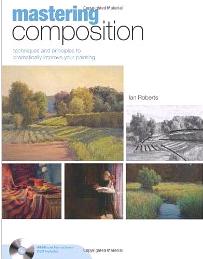
Mastering Composition - techniques and principles to dramatically improve your painting, by Ian Roberts.  ISBN No. 978-1-58180-924-4

After a brief introduction, Roberts define: “What Is Composition” with a illustration of five planes of a painting:
  • The format: square, landscape, portrait..., “The Four Most Important Compositional Lines”, the edge of your painting.
  • Armature: the direction or flow of the main movement of the painting
  • Abstract Shapes: the main masses, their relationship to each other, and their interaction.
  • Subjects: Bottles, mountains, people, a river...
  • Details: A street lamp, a pearl earring, a distant figure, trees.

With reference to points 1-3 Ian said: "This is where the real artistic thinking has to occur before you start to paint". Points 4-5: "This is where inexperienced painters focus their attention. The result is a lack of artistic clarity and drama in their paintings".

Chapter One discusses Armatures with a study of the Masters, a discussion of Eight Common Armatures, twelve composition basics, and ends with a demonstration. This chapter also includes a very brief excursion into "The Four Most Important Compositional Lines".

Cropping and Framing are covered in Chapter Two with thoughts on Value Masses, Viewpoints, use of the viewfinder and another demonstration on planning big masses. Chapter Three discusses Color Shapes, the Color Wheel with a discussion of flow in the picture plane in Chapter Four. The accompanying DVD is also introduced.

Chapters Five and Six are the inclusion of almost mandatory padding in a 'Gallery of Greats' and a gallery of the authors paintings.

The DVD provides an animated view of changes in color and value that demonstrates the author ideas on composition. There are two sections. The first section with commentary, illustrates how changes in value or color affect the composition of a picture. The second section is identical without the commentary.

Personal assessment of content: 
  • The good: A great overview of composition. The simplicity of the framework of the 5 picture planes was a major learning point for me 
  • The Bad: Doesn't follow through on the overview as explained in the introduction. It was a perfect table of contents for a book on composition . 
  • The Ugly: Unnecessary padding of the “Gallery of Greats” and single media (oil) view of painting.

In his introduction, Ian Roberts nails composition with his 5 visual planes. I just wish he would have used this introduction as an outline for the remainder of the book. Some of the assumptions and comments regarding non-oil media are incorrect. Composition subjects are mostly limited to landscapes and still life. Finally, I would also suggest that the Elements and Principles of Design, which is not mentioned in this book, needs to be added.

The DVD, in my opinion, did not contribute significant additional material.

Personal prejudice: I not particularly endeared to the authors painting style and that distracts from my own learning experience. YMMV

Suitability for beginners, intermediate or advanced: Intermediate onward

Score on a scale 1-5 (1=poor 5=excellent): Best book I've found so far on composition, but limitations and omissions as noted suggest a score of 3-4


That was my initial assessment of Ian’s book.  In a separate discussion on Wet Canvas art forum I opined: “Ian Roberts' ‘Mastering Composition’ is the only book I've found that provided a framework for visual composition. Before the first chapter he defines ‘What is Composition’. After reading these two pages I knew I now had a framework for composition that I understood and could apply to my paintings. The proverbial light bulb was lit. Decide the format and size, apply an armature, block in the abstract shapes, refine these into subjects and add the details. Great! Five steps. Big steps no doubt, but a framework I understood.”

Before Ian’s book, I had read and re-read numerous articles on the 7 elements and the 8 principles of design, but lacked a framework, a gestalt, an integration of the elements and principles.  Individually each made sense, but how did I apply them to creating a painting?  Ian pulled it all together for me.  All was good in paradise except the more I painted and the more I studied composition and design, the more I realized that I needed more than the 5 picture planes.

What about a colour plan, and had I considered the mood I wanted to express?  Indeed, what was about the scene before me that stirred me to paint it in the first place?  I needed another picture plane before the 5 that Ian described.  A zero plane.  The emotional plane.  Before I did the first preliminary thumbnail sketch, I needed to note down something about the emotions I felt about the painting I was going to create.  I also needed to consider the value range.  Should I use a high tone with a broad range or would it be better suited to a muted low tone value plan.  I also needed to give attention to what I’m going to leave out of the scene.

Not all of these items can be resolved immediately but a brief note to myself is a good starting point for any painting and it might contain a title once finished.  On the other end of a painting, once the details have been added, the mat and frame are needed to complete any painting: Picture Plane 6, for a total of 7 picture planes and we still need to consider the process of getting started.  No one ever said that design and composition was either simple or easy.